Parallel agent cockpit
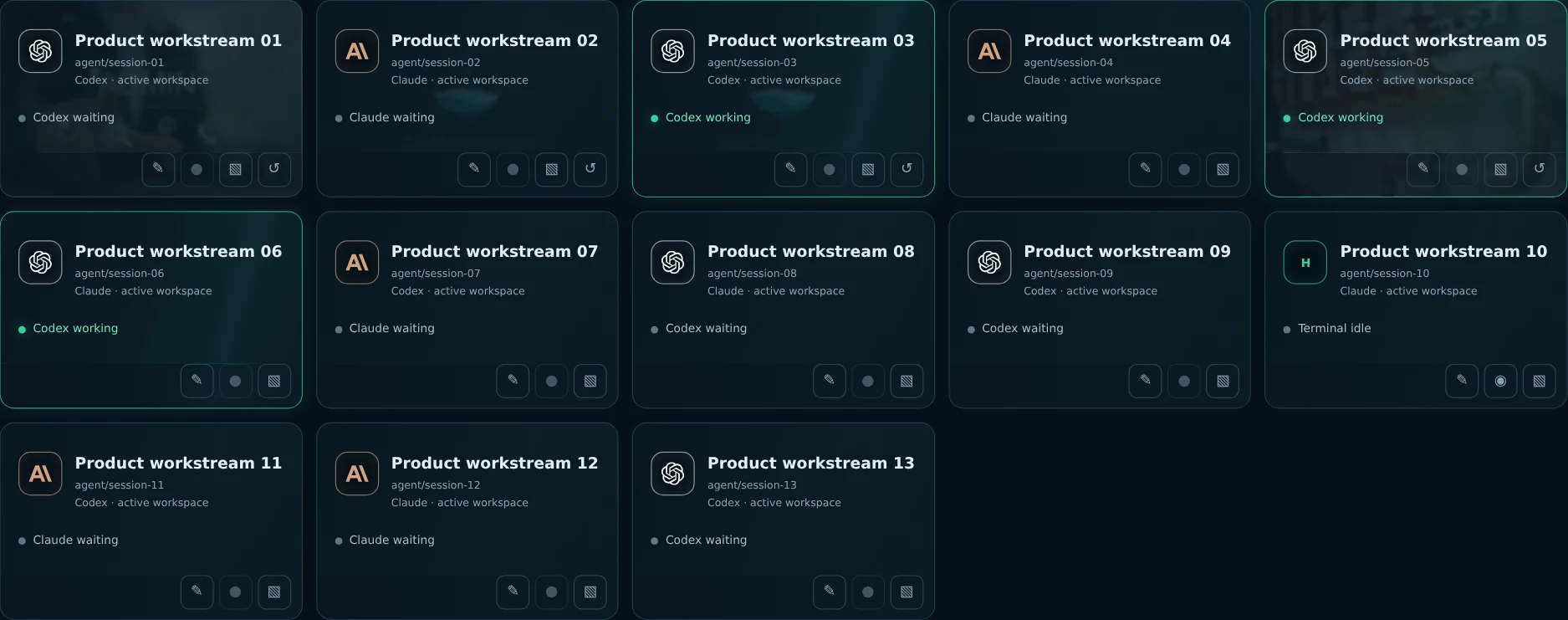
See every tmux workstream as a card with provider, model and working/waiting state, then focus the live terminal without hunting through shells.
04 / Local AI-agent operations console
Server Harbor is a security-first local command centre for teams operating servers and many AI coding agents at once. It joins a live tmux session cockpit with host health, Kubernetes, traffic, governed logs, transfers, documents and audited agent interaction.
Not a concept render
Live product evidence: 13 simultaneous sessions in the captured operating view; Codex/Claude detection and six adapter families; readiness-aware queues; host/Kubernetes/traffic/log views; controlled attachments; localhost-only access; and content-minimising audit.
Server Harbor capabilities
Server Harbor is a connected product system. These capabilities are implemented in its current architecture, interfaces and operating workflows.
See every tmux workstream as a card with provider, model and working/waiting state, then focus the live terminal without hunting through shells.
Understands Codex, Claude, Gemini, Aider, Kilo and OpenCode commands and controlled menu interactions instead of treating every terminal as raw text.
Queue the next instruction, review it, and optionally send only when the selected agent is actually ready.
CPU, memory, RAID, disk, processes, failed services and workload health sit beside the agent sessions acting on them.
Inspect per-application ingress activity, masked addresses and allowlisted journal/file logs through a no-shell privileged broker.
Deliberately unlock input, preserve bracketed-paste semantics, attach files with 0600 permissions and divert oversized prompts to reviewed attachments.
The current console is loopback-only, reached by SSH tunnel, authenticated by an HTTP-only session and never exposed as public server administration.
Record login, safe action and terminal-send events while deliberately excluding the sensitive message contents from the audit log.
Used by Infinovation
Server Harbor is not an imagined future dashboard. During this work it was actively coordinating this Codex session and multiple other agents. The captured interface contains 13 real concurrent workstream cards with project names and paths replaced before the image was written.
Real-world comparison / Portainer, Rancher, Lens, tmux and agent dashboards
Compared with Portainer, Rancher, Lens, tmux and agent dashboards on the work each product is designed to do. This is positioning by architecture and workflow—not a claim that every product serves the same user.
Common questions
It is used internally and in a private enterprise beta. Public release plans are still being shaped around security and operational feedback.
Yes. The current console detects and manages Claude Code and Codex terminal sessions, with an adapter model for other terminal agents.
No. The current design binds to loopback and is accessed through an SSH tunnel. Avoiding a public control plane is a central product decision.
Start a conversation
Use it now, or talk to us about how it fits your software and infrastructure.