Featured now: Start with Jaawac’s free beta, or request access to the AnchorScape pilot.
Try Jaawac Request AnchorScape

Product comparison / updated July 2026

Plumb vs Claude Code, Codex, Gemini CLI and GitHub Copilot

Claude Code, Codex, Gemini CLI and Copilot are capable coding agents. Plumb is the governed delivery engine around whichever model does the implementation: it turns requirements, oversight, completeness and release integrity into executable controls.

REAL PLUMB INTERFACE
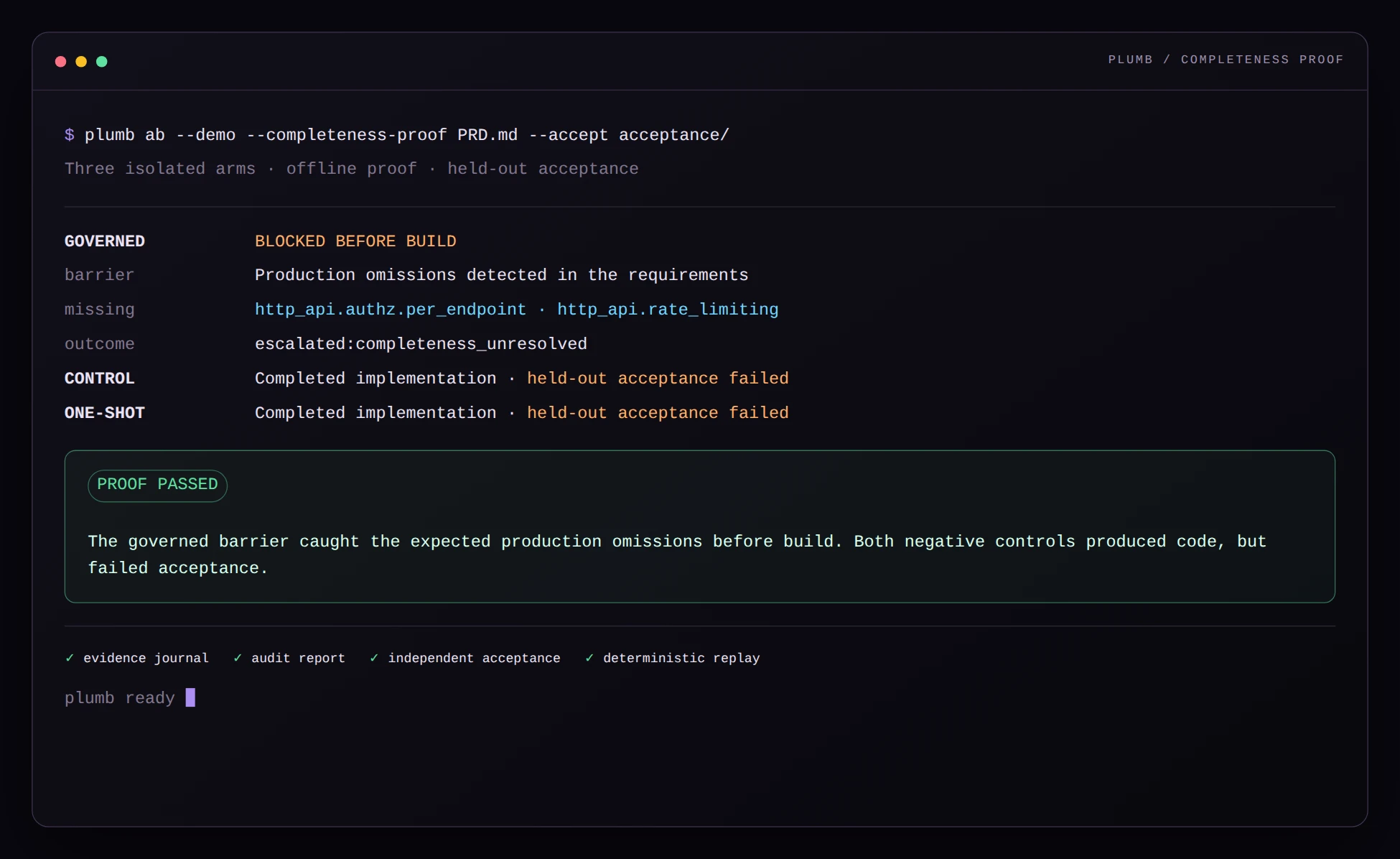
A real Plumb completeness proof showing the governed build blocked missing authorization and rate limiting while two code-producing controls failed acceptance

Implemented and tested: governed/resumable orchestration, independent invariant certification, adversarial role separation, sandboxed tools, encrypted secret vaults, provider routing, completeness proof, certified releases, deployment health checks, auto-rollback, durable audit and CLI packaging.

Direct market comparison

Compare the operating model, not a checklist.

The products overlap, but they are not interchangeable. These are the practical differences between Plumb and Claude Code, OpenAI Codex, Gemini CLI and GitHub Copilot.

Market axisNamed alternativesPlumb
Interactive codingClaude Code and Codex are frontier coding agents that read repositories, edit files, run commands and complete substantial engineering tasks.Plumb can route capable models but makes the delivery harness—not one model—the authority over requirements, review and release.
Open-source coding agentGemini CLI brings an open-source terminal agent and Google model/tool ecosystem.Plumb adds provider-neutral routing, executable invariants, adversarial seats and a release certification chain.
IDE and repository assistanceGitHub Copilot combines editor assistance, chat and coding agents closely with GitHub workflows.Plumb is built for governed end-to-end delivery, including completeness proof, byte-exact promotion and deployment reconciliation.
Quality controlCoding agents can run tests and follow repository instructions; CI validates the resulting branch.Plumb locks governance paths, independently certifies the tests, challenges omissions and preserves evidence at every oversight boundary.
01

Model capability and delivery governance are different layers

A frontier agent can read a repository, write excellent code and run tests. Plumb does not pretend that capability is unimportant. It makes a different layer authoritative: formal invariants, independently certified tests, adversarial seats, locked governance paths and explicit oversight boundaries.

02

Completeness is tested, not assumed

Plumb includes a three-arm offline proof. The governed barrier detects missing production obligations before build, while a control without the barrier and a one-shot arm can both produce plausible code and still fail held-out acceptance.

03

The outcome is a certified release

Plumb revalidates artifact bytes, promotes the same code hash through environments, runs health checks, reconciles interrupted deployments and can roll back automatically. Its durable journal connects the original requirement to the operated result.

Start a conversation

See Plumb as the complete system.

Plumb ships a real offline completeness proof. In the captured run, its governed barrier stopped missing per-endpoint authorization and rate limiting before build; a governed control without that barrier and a one-shot implementation both produced code and both failed held-out acceptance.

Discuss private access